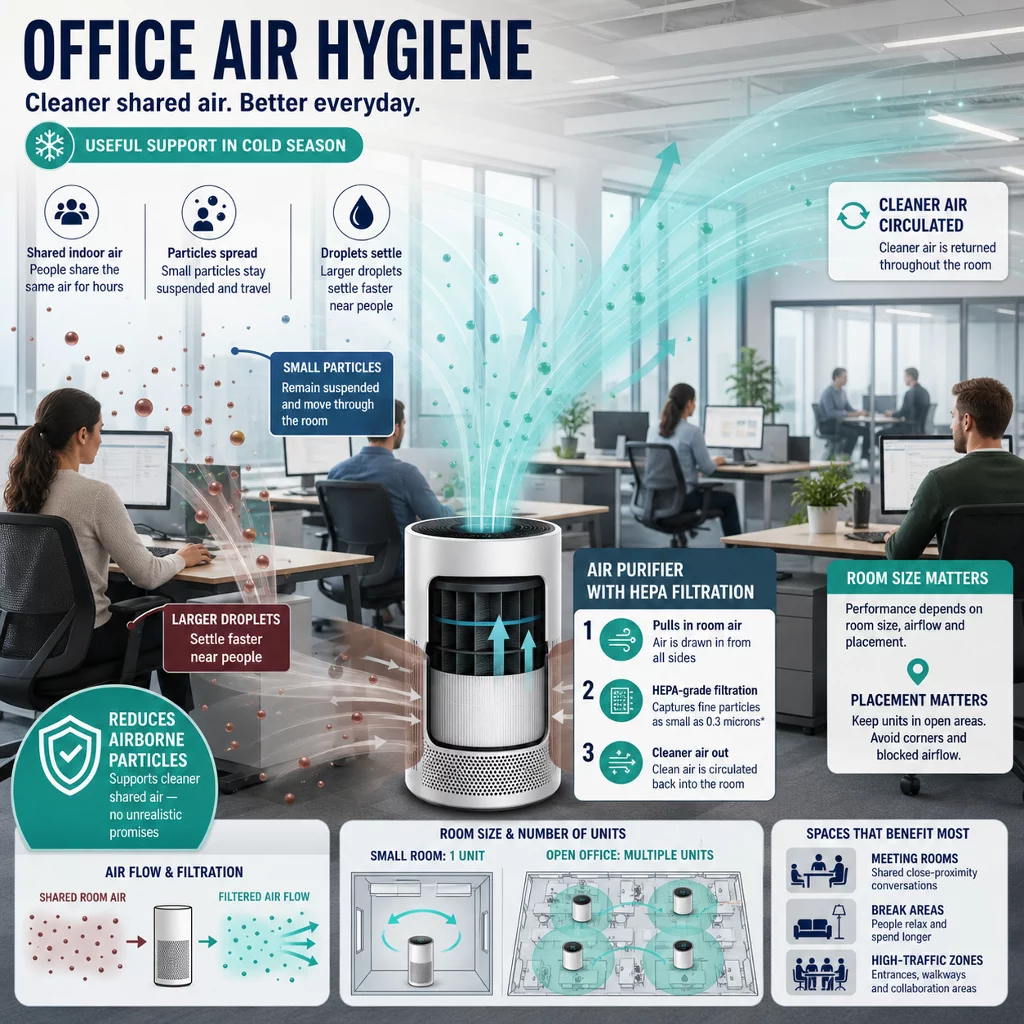
Larger droplets
Some respiratory droplets are bigger and settle relatively quickly. That is the part people picture first. It still matters, especially at close range, but it is not the whole indoor air story.
Office air hygiene
Office air gets complicated fast once people share the same room for hours. In winter that gets even trickier. Windows stay closed more often, meetings move indoors, and one person with a cold can turn the whole room into a place where everyone is breathing the same stale air.
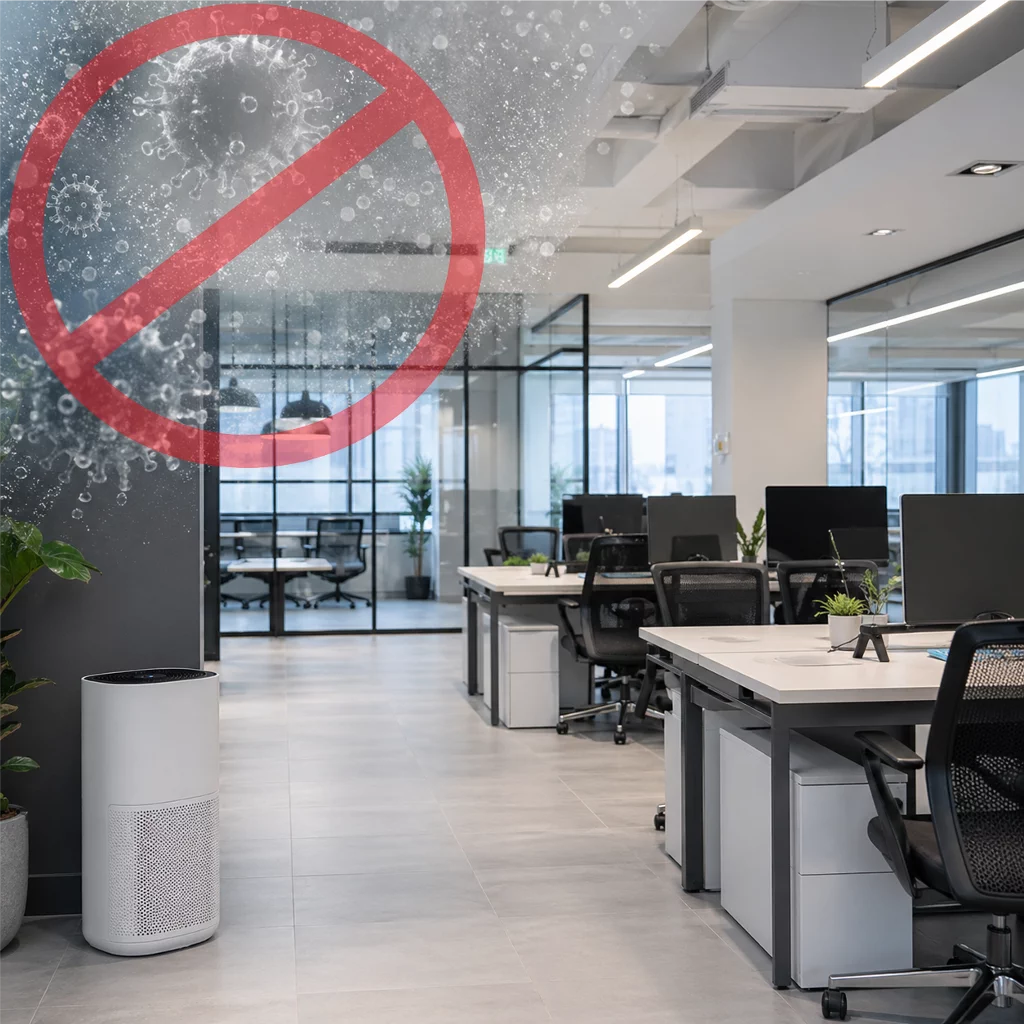
An air purifier does not promise that no one gets sick. That would be the wrong way to talk about it. What it can do is reduce airborne particles in the room, including the smaller particles that can stay suspended in shared indoor air. In an office, that is useful because it changes the air everyone is sharing.
Why office air matters
In a typical office, people sit together for long stretches. They talk, cough, laugh, take calls, hold meetings, walk around, then come back again. All of that affects indoor air. It is not only about smells or stuffiness. It is also about the fine particles that get released into the room and stay there for a while.
In the colder months this becomes more obvious because many offices ventilate less naturally. Windows stay shut, meeting rooms fill up, and the same air gets shared over and over. When one person comes in with a cold, that can be frustratingly noticeable, even if the office looks perfectly clean.
This is where air purification makes sense as part of general indoor air hygiene. It is about lowering the airborne load in the room, not making unrealistic promises.
Airborne background
The short version is that not everything falls to the floor right away.
Some respiratory droplets are bigger and settle relatively quickly. That is the part people picture first. It still matters, especially at close range, but it is not the whole indoor air story.
Smaller particles can remain suspended in the air longer and move across the room with normal airflow. In shared office spaces, those particles are the reason ventilation and filtration matter so much.
Once a room is occupied for hours, the issue is often not one single cough in isolation. It is the ongoing build-up and mixing of room air. That is why cleaner air strategies are usually discussed for offices, schools and meeting rooms rather than just for homes.
How purifiers help
A portable air purifier works by pulling air through a filter and pushing cleaner air back into the room. If it uses HEPA-grade particle filtration, it can capture a large share of the fine particles moving through it. In an office, that means the unit keeps cleaning the shared room air as people use the space.
This is why they are often discussed together with ventilation. Ventilation brings in cleaner air from outside or through the HVAC system. Air purifiers add more cleaned air to the room by filtering what is already indoors. CDC describes this as adding equivalent air changes per hour, or eACH.
So the technical background is simple enough: if you increase the amount of clean air in the room and keep removing airborne particles, you reduce the concentration of that material in shared air. That is useful in workplaces, especially during cold season when people are indoors more and rooms can get stale fast.
Sizing the space
This is one of the most common mistakes.
Start with the room size in square meters and the ceiling height. That gives you cubic meters of air. Then compare that with the purifier's airflow or CADR. In simple terms, CADR or airflow divided by room volume tells you how many air changes per hour the unit can add.
Also check out our calculator here if you want to easily find the right air filter for an office space or want to check if a certain model would likely be sufficient.
For shared indoor spaces, aiming for about 5 or more air changes per hour of clean air is a useful reference point. That clean-air total can come from the existing HVAC system, natural ventilation and portable purifiers together. If the base ventilation is weak, the purifier needs to do more of the work.
A quick example: if an office room has 120 cubic meters of air and a purifier provides 600 cubic meters per hour of clean air, that is about 5 air changes per hour from that unit alone. If the room is bigger, or if the airflow is lower, the result drops fast.
How many units
There is no single number that works for every office. A small private room may only need one well-sized unit. An open-plan office usually needs several, because it is not just about total airflow. It is also about how well the cleaned air is distributed through the space.
If one purifier is stuck in a far corner of a big open office, people on the other side may get much less benefit. In larger rooms it is often better to use two or more units spread through the space rather than one oversized machine at one end.
Meeting rooms deserve separate thought too. They are often the places where several people sit in a smaller enclosed space for an hour or more. Even if the main office is covered, a shared meeting room may still need its own purifier.
What else matters
Portable units are useful, but they work best alongside decent ventilation and sensible room use. If the HVAC system is working well, that helps. If windows can be opened without making the room freezing or noisy, that can help too. If filters are not changed on time, even a good purifier becomes less effective.
Placement also matters more than people expect. Do not hide units behind cabinets or put them where air cannot move properly. Give them some space. Keep intake and outlet paths clear. In open offices, think about actual work zones, not just where there happens to be an empty plug.
The realistic message is this: office air purifiers can support a lower-risk, cleaner shared indoor environment by reducing airborne particles in the room. They are not a medical device and they do not guarantee that no one gets ill. But during the cold season, in crowded rooms and in offices with limited ventilation, they are a sensible part of better indoor air hygiene.